Burger buns: a guide to bun types for foodservice operators
Milk, sesame, potato, wholemeal, pretzel, coloured: how burger buns differ and how to match them to your menu.
A burger bun is more than just a container: it's the first texture a customer notices when they bite in, and it often determines whether a burger holds together to the last bite or falls apart halfway through. Understanding the differences between bun types helps build a coherent menu and reduce waste.
What makes a bun suitable for burgers
Before looking at individual types, it's worth setting out three requirements that apply to any burger bun:
- Crumb structure: it needs to be dense and elastic enough to hold the juices from the meat and sauces without turning into a soggy sponge.
- Thin, soft crust: a bun with too crisp a crust tends to push the filling out of the sides when bitten.
- Proportion to the filling: the bun should complement the patty, not overpower it. A bun that's too tall or too heavy will unbalance the burger.
The main bun families
Classic sesame-topped bun
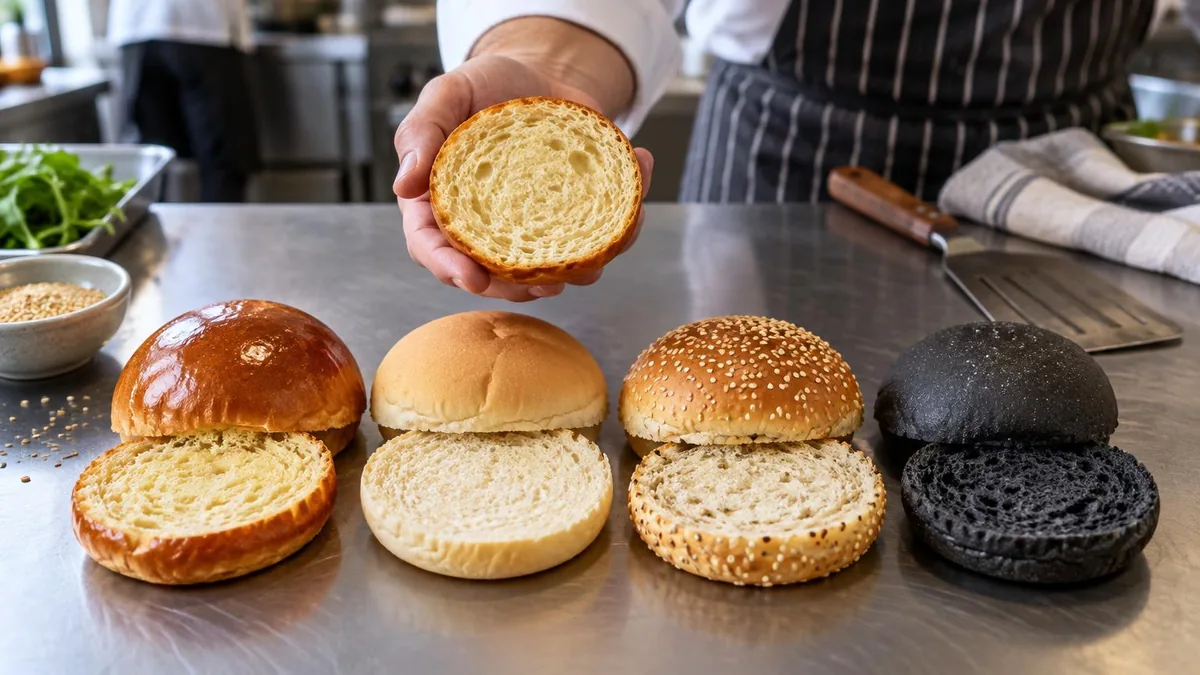
This is the historic benchmark: a dough made from wheat flour, water, yeast, salt and a modest amount of sugar and fat, with a sesame-seed topping. It has a neutral flavour and an even crumb, suited to traditional recipes with cheddar, lettuce, tomato and classic sauces. It's a versatile choice for operators who want a single bun to cover several menu items.
Worth remembering: sesame is one of the 14 allergens that must be declared under Regulation (EU) 1169/2011, so it needs to be clearly indicated on the menu or in the venue's allergen register.
Brioche bun (sweet preparations only)
The brioche bun contains a high proportion of butter (or other fats), eggs and sugar: a soft, stringy crumb, a glossy golden crust and a distinctly sweet flavour.
It is not suitable for savoury burgers or hot dogs: its sweetness becomes cloying when paired with meat, sauces and full-flavoured cheeses. Brioche is suited to sweet preparations — desserts with cream, ice cream or sweet pairings — not to traditional burger service. It contains eggs and milk, which must be declared among the allergens.
Milk bun
A middle ground between the classic bun and the brioche bun: milk (often combined with a moderate amount of fat) gives a fine, soft crumb, with a milder sweetness than brioche. It suits chicken burgers and recipes with delicate sauces.
Potato bun
Part of the dough is made up of potato, in the form of mash or flakes. Potato helps retain moisture, giving a compact, moist and very soft crumb, often with a slightly yellow colour. It's one of the most common choices for smash burgers and burgers with several thin layers of meat, because it compresses well without breaking.
Wholemeal and multigrain
Wholemeal or mixed-grain buns have a more rustic flavour and a denser crumb, sometimes with seeds on the surface or in the dough (sunflower, linseed, oats, sesame). They pair well with vegetable burgers, recipes with full-flavoured cheeses and grilled vegetables. Check the technical data sheet: the terms "wholemeal" and "multigrain" can correspond to very different formulations from one product to another, both in terms of wholemeal flour content and seed type, and some seeds may introduce additional allergens.
Pretzel bun
Recognisable by its glossy, reddish-brown crust, achieved by dipping the dough in an alkaline solution before baking, and often finished with coarse salt. It has a firmer crust and a distinctive flavour that pairs well with mustard, melted cheese, pork and onion. It works well for special offerings, less so as the sole bun on the menu.
Ciabatta rolls and traditional Italian breads
Some venues choose a ciabatta roll, a rosetta or an olive-oil bread roll to give the burger an Italian identity. These have a more open crumb structure and a crisper crust: they work well with fillings that are lighter on sauce (for example meat, aged cheese, grilled vegetables, a drizzle of oil), while very juicy recipes risk leaking liquid through the open crumb.
Black buns and coloured buns
Black buns are generally coloured with squid ink or vegetable carbon, depending on the manufacturer's recipe; coloured versions made with vegetable ingredients also exist. These are primarily a visual-impact choice. It's worth reading the label carefully: squid ink implies the presence of molluscs, an allergen that must be declared, and the use of colourings is governed by additive regulations.
How to match the bun to the recipe
A general guide, to be adapted to your own kitchen:
| Type of burger | Buns often paired | Why |
|---|---|---|
| Classic beef, cheddar, traditional sauces | Sesame-topped, milk bun | Neutral flavour, even structure |
| Multi-layer smash burger | Potato bun, milk bun | Softness, good compressibility |
| Gourmet with bacon and full-flavoured cheeses | Pretzel bun, milk bun | Savoury contrast, structure |
| Fried or grilled chicken | Milk bun, potato bun, sesame-topped | Soft crumb that complements the breading |
| Vegetable | Wholemeal, multigrain, sesame-topped | More rustic flavour profile |
| "Italian-style" offering | Ciabatta roll, olive-oil bread roll | Identity and crisp crust |
Practical criteria:
- Diameter relative to the patty: the bun should cover the meat after cooking, allowing for shrinkage. As an indicative reference, many venues use buns of around 10 to 12 cm in diameter for medium-weight patties, but the right size depends on your own bun weight.
- Weight: common burger buns generally weigh between 60 and 100 g; smaller formats are used for sliders and catering.
- Cut: pre-sliced or whole changes service times and line management.
- Toasting: brioche and milk buns toast quickly; pretzel and ciabatta rolls need more time or heat.
How many bun types to keep on the menu
Too wide a range complicates ordering, stock management and staff training: many venues work with one main bun and one or two alternatives. Operators who also want to offer a bun labelled "gluten-free" should remember that, under Regulation (EU) 828/2014, this labelling is reserved for products containing no more than 20 mg/kg of gluten in the finished product, and that separate management of equipment and surfaces is needed in the kitchen to limit cross-contamination.
Before deciding, it's worth serving the same burger with two or three different buns and assessing how well they hold up, how easy they are to bite through, and how they perform after a few minutes' wait.
Frequently asked questions
What is the best bun for burgers?
There's no single best bun overall. The sesame-topped bun remains the most versatile, the potato bun is widely favoured for smash burgers, and the milk bun for chicken. The brioche bun is suited only to sweet preparations, not to savoury burgers.
What's the difference between a brioche bun and a milk bun?
Brioche generally contains more butter, eggs and sugar, giving a richer crumb and a sweeter flavour. The milk bun is soft but more neutral. Exact proportions vary from recipe to recipe: the product's technical data sheet is the reference to check.
Should burger buns always be toasted?
It's not compulsory, but briefly toasting the cut side creates a surface that slows down the absorption of juices and sauces.
How many bun types should a burger restaurant keep on hand?
Generally, one main bun plus one or two alternatives is enough. More SKUs mean more complexity in stock and allergen management.