Bread R&D: What a Historic US Bakery Teaches Burger Operators
How a historic US bakery tracks bread trends, and what a restaurant operator working with burger buns can learn from its R&D approach.
What is happening
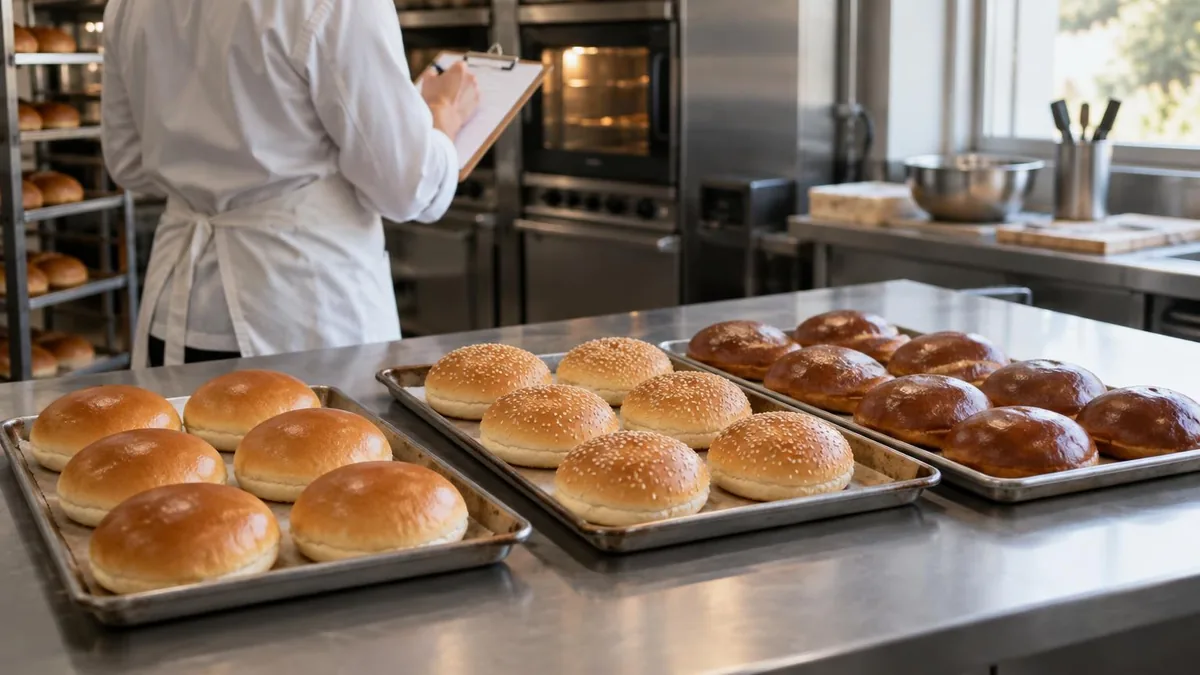
The US trade magazine Baking Business has published an interview in its 'Meet the Baker' series with Bryan Pasquesi, head of research and development at a historic bakery in the United States. According to the summary of the source, the subject is twofold: which trends are visible in the bread category today, and how the R&D team is approaching them.
A note on method: we worked from the title and summary of the interview, so we do not report statements or data that we have not seen. Anyone who wants the full detail will find the link in the Sources section.
Why write about it, then? Because it is not a product to copy but a method: a long-established baking company that keeps a permanent function dedicated to watching how consumption changes and turning it into recipes, formats and finishes. It is an idea that a restaurant operator can also use, on a much smaller scale.
Why it works there
The US market has features that make a structured R&D department a natural fit:
- large baking businesses, often with decades of history, serving retail and restaurants at the same time;
- chains and formats that change their menus frequently and expect the bun to adapt to new burgers;
- competition that pushes brands to stand out even on details such as crumb, crust finish or size.
Think of how American formats grow by replication, as in the case of Subway's new digital format for expansion in Europe, the Middle East and Africa or the container sites of Smalls Sliders. In settings like these the bun is a component that has to be standardised and, at the same time, kept up to date: someone needs to look after it on an ongoing basis.
Brand partnerships, such as the co-branded site of Fatburger and Buffalo's Express in Texas, also show a market used to experimenting. There, a novelty on the bun can be tried, measured and, if it does not work, withdrawn.
Where the trend stands in Europe
Caution is needed here: we have no data on how many European restaurants or bakeries run a dedicated research and development process for burger buns, and we do not want to invent any. We cannot say how widespread the approach is across the continent.
What is easier to say is that replicating the scale is hard: a single restaurant does not have a development lab. It can, however, adopt the same logic by working with its trusted supplier or baker. For background on bun types, see the guide to burger bun types and the article on how bun choice is changing in gourmet street food.
How to put it into practice
The practical lesson is to treat the bun as a variable to test in an orderly way. A simple four-step process:
- Observe. Which burgers sell best, which come back, which complaints concern the bun (it falls apart, goes soggy, is too big).
- Form a hypothesis. For example: 'with the juicier burger we need a softer, sturdier bun'.
- Change one thing at a time. One type of bun for a set period, on one burger.
- Measure. Sales, waste, service times, customer comments.
How to choose the bun type, as a general guide only:
- classic burger on the menu: plain classic bun, sesame-topped; it is the most versatile base;
- very juicy burger or one with generous sauces: plain potato bun, seedless, with details in the article on the potato bun;
- smash burger: plain classic bun, seedless, in a compact size, as explained in the article on the bun for smash burgers;
- special or limited edition: dark-coloured bun, seedless, offered for a short period and then assessed;
- delivery: plain classic bun, sesame-topped, chosen for how well it holds up, as covered in burger buns for delivery.
The brioche bun stays out of savoury dishes: it is reserved for desserts with creams or ice cream.
Gluten-free: you need a procedure
If your trials include a plain gluten-free bun, seedless, remember that the term 'gluten-free' is permitted only under Regulation (EU) No 828/2014, that is, at or below 20 mg/kg. In the kitchen, what counts is procedures, separation of preparation, staff training and certified products, with reference to the guidance of the Italian Coeliac Association (AIC). No promise of zero risk is made. The overall picture is in the article on gluten-free burger buns.
Costs and risks
- Menu complexity: every extra bun means more stock, more mistakes on the line, more training. Better to have a few well-chosen types.
- Testing costs: trials, waste and kitchen time have to be factored in; look at the overall yield and not only the price per piece, with the help of the guide to bun sizes and weights.
- Storage: a new bun may need different handling (fresh, blast-chilled, frozen): see differences and shelf life.
- Supplier dependence: a novelty only makes sense if supply is reliable; the criteria for choosing a supplier help you check this.
The choice between artisan and industrial production also remains open, and it affects consistency, customisation and development times.
Frequently asked questions
Does a small restaurant need a bread R&D department?
No. A method is enough: note what works and what does not, change one thing at a time and compare the results. Talking to your baker or supplier does the rest.
Which American bread trends will reach Europe?
The source we consulted talks about trends in the category, but its summary does not list them and we cannot attribute any to it. For now it is better to look at the signals from your own restaurant than at generic forecasts.
How often should you change the bun on the menu?
There is no rule that suits everyone. A change makes sense when there is a concrete problem (hold, size, yield) or a burger idea to test; it is better to avoid constant changes that confuse customers and the kitchen.
Sources
- Meet the Baker: Gonella Baking’s Bryan Pasquesi — Baking Business