Smash burger buns: how to choose the right bread
Softness, griddle toasting, diameter and juice retention: how to choose the right smash burger bun and avoid common mistakes.
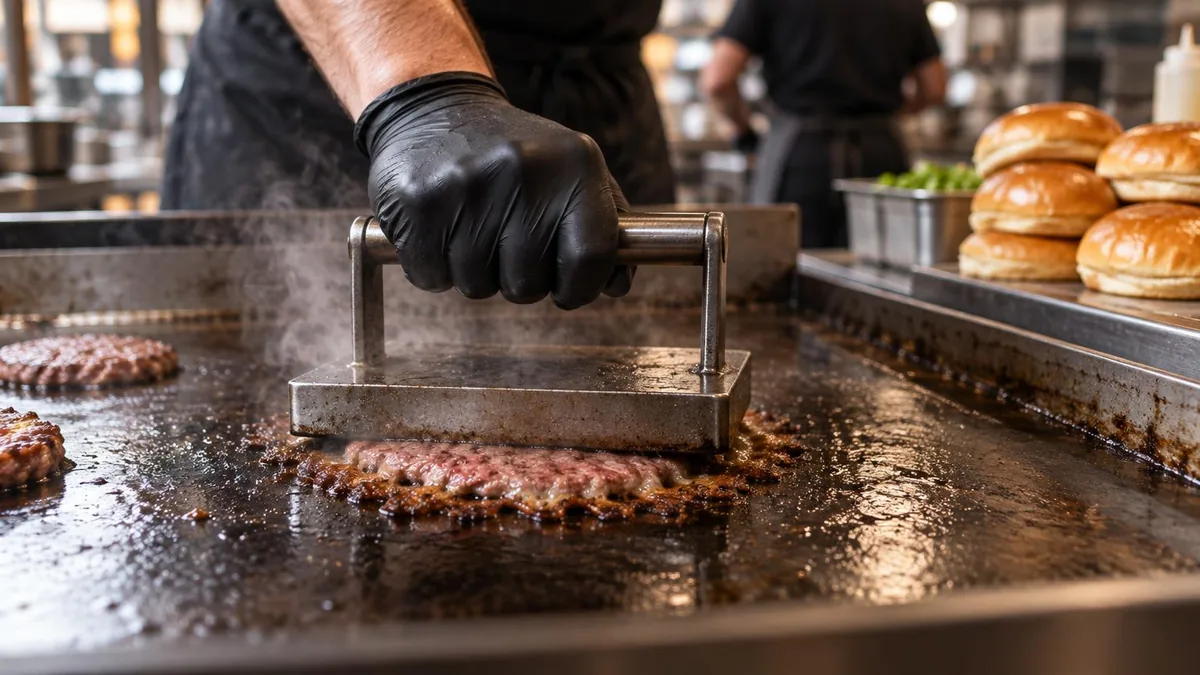
The smash burger has changed the way many burger restaurants think about the bun. The patty is pressed firmly onto the hot griddle, develops a thin, flavourful crust and ends up much lower than a traditional burger. Because of this, the bread plays a different role: it doesn't need to contain a tall, compact disc of meat, but rather accompany thin layers, irregular edges, melted cheese and sauces. Choosing the right smash burger bun means balancing softness, structure and size.
Why smash burgers call for a different bun
In a classic burger the patty is quite thick and acts as a kind of "load-bearing structure". In a smash burger the meat is thin, often in two or more layers, with cheese melting between each disc. The result is a soft, moist, fat-rich filling that tends to slide around.
The bun therefore needs to:
- compress easily, because a smash burger is eaten by pressing the bun down, and a rigid bun pushes the filling out;
- hold the juices without falling apart in the first few minutes after service;
- not dominate the bite: with thin patties, a bun that's too tall unbalances the ratio between bread and filling.
Softness and crumb structure
Softness is the first criterion. For a smash burger you want a bun with a fine, elastic, compact crumb that springs back after pressure but compresses without resistance. The crust should be thin, with no crunch: the crispness comes from the meat, not the bread.
At the same time, soft shouldn't mean flimsy. A crumb that's too open, with large air pockets, soaks up fat and sauce like a sponge and collapses. The ideal compromise is a crumb that is dense yet soft, typical of buns enriched with fat, milk or potato.
Potato bun: the main reference point
Potato bun
The potato bun is considered by many operators the natural choice for smash burgers. The potato in the dough helps retain moisture and gives a compact, very soft crumb with a delicate, slightly sweet flavour. It compresses well, toasts evenly and holds up well under layers of meat and cheese.
Brioche bun (sweet preparations only)
The brioche bun, rich in fat, eggs and sugar, is suited exclusively to sweet preparations: desserts with creams, ice cream and similar items. It is not suitable for smash burgers or savoury burgers: its pronounced sweetness doesn't pair with the savoury profile of the meat and classic sauces, and its high butter content makes it soften quickly.
Other options
A well-structured milk bun can also work, offering a more neutral profile. Less suitable are breads with a thick crust or an open crumb structure, such as small ciabattas or rustic breads, as well as very tall buns: they tend to overshadow the meat and make the burger difficult to bite into.
Griddle toasting and the use of butter
Toasting is almost essential for smash burgers. Warming the cut side of the bun on the griddle creates a golden, slightly sealed surface that slows down the absorption of juices and sauce and adds a toasted note that pairs well with the crust on the meat.
Some practical pointers:
- Butter or fat on the cut side: a thin coating of butter, clarified or not, helps achieve even browning. Some operators use the fat rendered from cooking the meat. It's a matter of style: the key is not to overdo it, so the bread doesn't turn greasy.
- Toast the inner side only: the outer side of the bun stays soft; at most it can be warmed briefly, for example by resting it on top of the meat while the cheese melts.
- Watch out for sugars: brioche and sweet breads caramelise quickly and can burn. It's best to work on a cooler part of the griddle or reduce the toasting time.
- Coordinated timing: toasting the bun needs to be synchronised with cooking the meat, which is very quick for a smash burger. Organising the line so that bread and meat are ready together stops one from waiting on the other.
Bun diameter relative to the smashed patty
This is one of the most underrated aspects. Smash burger patties spread out considerably as they're pressed down and then shrink back slightly during cooking; the edges stay irregular and are often the most appreciated part, crisp and caramelised.
Because of this, many operators choose a bun with a diameter slightly smaller than or similar to the cooked patty, so the edges stick out a little and remain visible. As a purely indicative reference, buns between roughly 9 and 11 cm in diameter are common for single or double smash burgers with smaller portions of meat, but the size should be calibrated to your own bun weight, the pressure applied and the visual effect you want.
A bun that's much bigger than the patty, on the other hand, gives the impression of an "empty" bun and throws off the ratio between bread and filling.
Height matters too: a low or medium bun suits thin layers better. If you're serving smash burgers with three or more layers, it's worth considering a slightly taller or more structured bun.
Structure that holds the juices
With the fat from the meat, melted cheese and sauces, the base of the bun is the part most exposed. A few tips:
- always toast the base;
- place runnier sauces on the top half or over the cheese, not directly on the untoasted base;
- consider using a lettuce leaf or a slice of cheese as a barrier;
- for delivery, consider a bun with a slightly more robust structure and test in real conditions how well it holds up after the average delivery time.
Common mistakes
- Using a bun that's too tall or too firm: the filling slides out on the first bite.
- Not toasting the bun: the base turns soggy within minutes.
- Disproportionate diameter: too large and the bun looks empty; too small and the meat falls out the sides.
- Burnt brioche bun: sugar and butter content require moderate heat.
- Leaving the bun waiting around: toasted too early, it loses heat and softness.
- Choosing without testing: every griddle, recipe and service time is different. A side-by-side test with two or three buns, serving the burger and observing it even a few minutes later, is worth more than any spec sheet.
Frequently asked questions
What's the best bun for a smash burger?
The potato bun is the most widely used choice for its softness and ability to compress; a well-structured milk bun is a valid alternative. The brioche bun is only suitable for sweet preparations, not for savoury burgers.
Should the smash burger bun be toasted with butter?
It's not essential, but a thin amount of butter or fat on the cut side helps achieve even browning and protects the crumb from the juices. The key is not to overdo it, so the bread doesn't turn greasy.
Should the bun be bigger or smaller than the patty?
For smash burgers, a bun with a diameter similar to or slightly smaller than the cooked patty is often preferred, so the crisp edges remain visible. The size should be calibrated to your own bun weight.
What bun should be used for smash burgers in delivery?
A soft bun with a dense crumb, well toasted on the base. It's worth testing the burger after the average delivery time to check how well it holds up.