Artisan or industrial burger buns: how to choose for your restaurant
Ingredients, fermentation, labelling, consistency and cost per cover: how to compare artisan and industrial burger buns and assess a supplier.
Choosing between artisan and industrial burger buns is one of the decisions that most affects the identity of a burger restaurant, as well as kitchen organisation and food cost. This is not about deciding, in the abstract, which of the two is "better": it is about understanding which production model best suits your venue's concept, volumes, available space and type of service.
In this article we compare the two approaches in terms of ingredients, fermentation, shelf life, consistency and costs, and offer a framework for assessing a burger bun supplier for restaurants.
What "artisan" and "industrial" mean
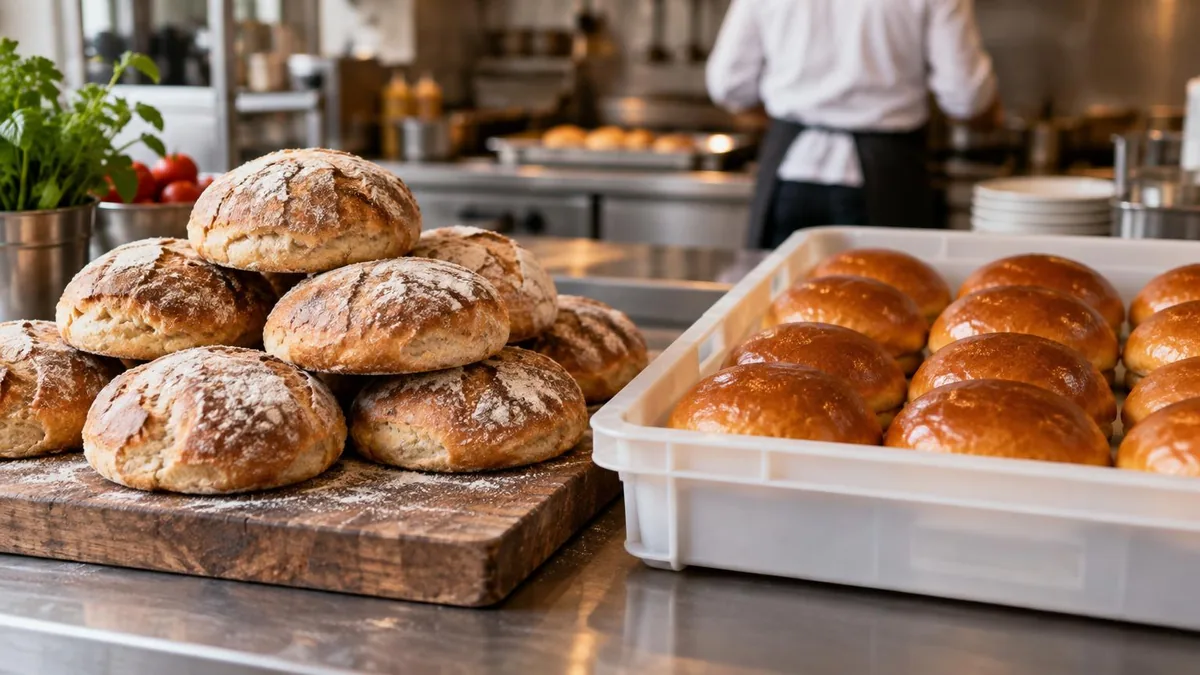
In everyday trade language, artisan refers to buns produced in relatively small batches, with a significant share of manual or semi-manual work and more flexible production times. Industrial refers to production on automated lines, with large volumes, standardised processes and often regional or national-scale distribution.
It should be said clearly that the word "artisan" on labels or in marketing is not an automatic guarantee of a specific recipe or level of quality: the real difference lies in the ingredients, the process and the controls in place. Likewise, "industrial" is not a synonym for poor quality: many large-scale producers work with carefully developed recipes and rigorous control systems.
Ingredients and formulation
A basic bun requires flour, water, yeast and salt; depending on the style, sugars, fats (butter, vegetable oils), milk, eggs, potato and seeds are added.
- In artisan production, the ingredients list tends often to be shorter and to favour recognisable fats and ingredients, but this depends entirely on the choices made by each individual bakery.
- In industrial production, in addition to the basic ingredients, additives and processing aids may be used to stabilise the dough on automated lines, keep it soft for longer or ensure consistent volume: emulsifiers, flour treatment agents, preservatives.
The only reliable source is the product's ingredients list and technical data sheet, which the supplier must be able to provide. Regulation (EU) No 1169/2011 sets out the rules for the ingredients list, allergens and other mandatory information for pre-packaged products.
Fermentation: sourdough starter and baker's yeast
Fermentation is one of the areas where the differences are most noticeable.
Baker's yeast and straight dough fermentation
Baker's yeast (fresh or dried) delivers rapid, predictable fermentation. It is the most widely used option both in bakeries and in industrial production, because it allows for short timescales and consistent volume. With a short fermentation, the crumb is generally soft and uniform, with a simpler flavour profile.
Sourdough starter and pre-ferments
Sourdough starter (natural yeast) and pre-ferments such as biga and poolish extend the timescale and introduce a more complex fermentation. The result is generally a more articulated flavour profile and a different crumb structure. The trade-off is more demanding management: the starter needs to be refreshed regularly, and its activity varies with temperature and season.
A note of caution applies here too: a product may contain sourdough starter alongside baker's yeast. If sourdough is a selling point for the menu, it is worth asking the supplier how it is used and exactly what the label states.
Production times
A long fermentation, perhaps including a stage of cold retarding, requires planning and space. For an artisan bakery this means scheduling well in advance; for the restaurant operator it means placing orders with longer lead times. Industrial producers tend to work to fixed production schedules, with continuous availability of standard lines.
Shelf life, preservatives and labelling
The shelf life of a bun depends on the recipe, moisture content, packaging, any preservatives used and the distribution method (fresh, blast-chilled, frozen).
- A fresh artisan bun with no preservatives generally has a short shelf life and should be used within a short timeframe, or frozen according to the producer's instructions.
- A packaged industrial bun can have a longer shelf life thanks to modified atmosphere packaging, any preservatives used and controlled production processes.
For the restaurant operator, the practical question is: how much bread can I use before it loses quality? If covers fluctuate, a longer shelf life or the option to freeze reduces waste. On pre-packaged products, the date must be respected as stated on the label, distinguishing between "use by" and "best before".
Product consistency
Consistency is one of the strengths of industrial production: diameter, weight, height and colour are generally very uniform from one batch to the next. For a chain or a high-cover venue, this means predictable portioning, stable toasting times and a bun that is always the same.
In artisan bread, a degree of variability is normal. A good bakery keeps it within acceptable limits through dough weighing, moulds or forming equipment, and temperature control. When assessing a supplier, it is worth requesting samples from different batches and measuring them: diameter, weight and height say a great deal about how rigorous the process is.
Cost per cover: how to think about it
Comparing only the unit price of the bun is too narrow an approach. The real cost per cover includes:
- unit price and delivery terms and minimum order quantity;
- waste: unsold, expired or transport-damaged buns;
- kitchen labour: slicing, regeneration, toasting;
- storage: space in the dry store, fridge or freezer and related running costs;
- commercial return: a bun with higher perceived quality can support a different menu price.
A more expensive bun with less waste can end up costing less over the course of a month than a cheap bun that is partly thrown away. The correct way to compare two suppliers is to calculate, using your own sales data, the actual cost per bun served, including the waste recorded over a representative period.
How to assess a burger bun supplier for restaurants
A checklist to use with both artisan bakeries and industrial producers:
- Complete technical data sheet: ingredients, allergens, weight, dimensions, storage conditions, shelf life and regeneration instructions.
- Free samples: test in your own kitchen with your recipe, your grill and your service times.
- Batch-to-batch consistency: measure samples received in different weeks.
- Logistics: delivery frequency, minimum order, lead time, and how urgent orders and holidays are handled.
- Traceability: batch coding and willingness to provide information in the event of non-conformity.
- Customisation: the ability to adapt diameter, weight, finish or recipe, and the minimum quantities required.
- Special lines: if gluten-free buns are needed, check that the product meets the 20 mg/kg limit set out in Regulation (EU) No 828/2014 and how separation is managed during production.
Frequently asked questions
Is an artisan burger bun always better than an industrial one?
No. Artisan and industrial describe production models, not guaranteed quality levels. It is best to assess the ingredients, kitchen performance, consistency and service of each individual supplier.
Can an artisan bun be frozen?
In many cases yes, but it depends on the recipe and the producer's instructions. Bear in mind that a product frozen on the premises must be indicated on the menu, in line with standard practice in Italy.
How do I compare the cost of two suppliers?
By calculating the cost per bun served, not just the unit price: include waste, labour, storage and delivery terms, using your own venue's real data.
What documents should I ask a new supplier for?
At the very least, a technical data sheet covering ingredients, allergens, storage and shelf life, plus batch and traceability information. These form the basis for the allergen register and for internal self-checks.