Burger bun sizes and weights for foodservice
Diameters, weights, mini buns for catering, bun-to-patty ratio, pre-slicing and cartons: how to choose the size and calculate weekly needs.
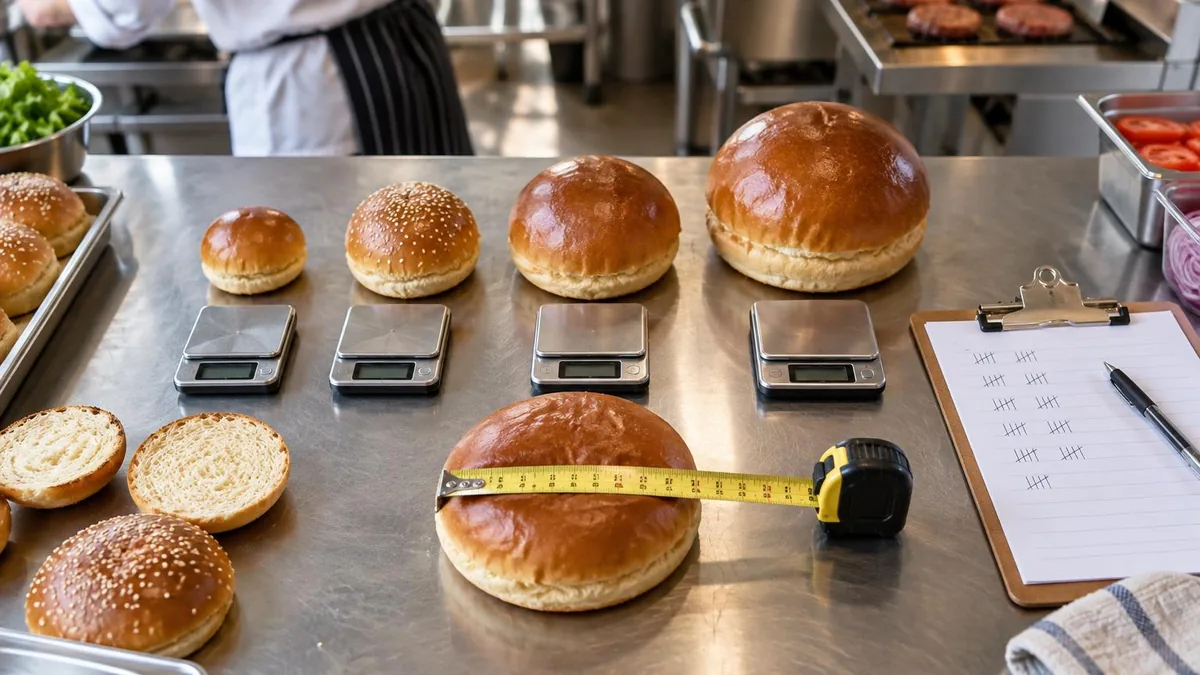
Choosing the bun for your menu isn't just about deciding between classic, sesame-topped or potato buns. Before you even think about the recipe, what matters is the size: diameter, weight, height, pre-slicing, packaging. These are parameters that affect plate yield, stock management and cost per cover. In this guide we set out the variables to consider and a simple method for estimating how many buns to order each week.
One caveat applies throughout this article: the measurements and weights given are indicative ranges commonly used in foodservice, not standards set by regulation. Each supplier has its own product range, and exact figures should always be checked on the product's technical data sheet.
Diameter and weight: the most common sizes
As a general rule, buns for foodservice can be grouped into three size categories.
| Size | Indicative diameter | Indicative weight | Typical use |
|---|---|---|---|
| Mini / slider | approx. 5–7 cm | approx. 20–35 g | catering, aperitifs, tastings, children's menus |
| Standard | approx. 10–12 cm | approx. 60–90 g | classic burger on the menu |
| Large | approx. 12–14 cm | approx. 90–120 g | double burgers, gourmet burgers, generous portions |
There's no single 'right' diameter: it depends on the patty. The most common rule of thumb is to choose a bun with a diameter equal to or slightly larger than the meat after cooking, bearing in mind that the patty shrinks on the griddle. A bun that's too wide leaves empty, dry edges; one that's too narrow lets the meat and sauces spill out, making the burger hard to eat.
Height matters too: a tall, soft bun creates an impression of generosity but can overwhelm a thin patty, while a lower one suits smash burgers and rich fillings better. When assessing samples, it's worth assembling the whole burger and checking it in profile.
Bun-to-patty ratio
There's no fixed ratio, but kitchens often work along these lines:
- patty of around 120–150 g (raw): a standard bun towards the lower end of the weight range given;
- patty of around 180–200 g or double patties: a full-weight standard bun or a large bun, with enough structure to hold juices and sauces;
- smash burgers (two or more thin patties): a soft bun, not too tall, often with a smaller diameter;
- mini burgers with around 30–50 g of meat: a mini bun, ideally with a dense crumb so it doesn't collapse.
The underlying principle is that the bun should complement the meat, neither overpowering it nor giving way under it. A very light bun on a very juicy patty will turn soggy within minutes; a bun that's too heavy on a thin patty shifts the flavour balance towards the bread. If the menu features burgers of different sizes, consider whether two bun sizes are enough to cover them all: every extra product line complicates ordering and stock rotation.
Mini buns and sliders for catering and events
The mini format follows its own logic. At catering events, burgers are often eaten standing up, in just a couple of bites, and may sit out on the buffet for a while. For this reason, it's worth prioritising:
- a dense crumb and a thin but present crust, to help the bun hold its shape;
- pre-slicing, which speeds up assembly when preparing large quantities;
- a decorated top (sesame-topped, mixed seeds, a glossy glaze) that makes the finger food easy to identify on the tray;
- a slightly sweet or neutral flavour that pairs with different fillings at the same event.
When quoting for an event, mini buns are calculated per piece per person based on the number of courses planned: this is an estimate that the catering team knows better than any table, and should be fine-tuned based on experience from previous events.
Pre-sliced or whole?
The pre-sliced bun saves time on the line and guarantees an even cut, which is useful when several staff members are assembling burgers in parallel. It's the most common choice for high-volume burger restaurants, dark kitchens and catering operations.
The whole bun, on the other hand, gives more freedom: it can be sliced at the preferred height (for example, cutting lower down for a taller top), and the crumb stays protected until use. Some venues prefer it for presentation reasons, or because they fill it in a particular way. The trade-off is the extra time required and variation in the cut from one staff member to another.
A middle ground is partial pre-slicing (a 'book cut', not fully separated), offered by some suppliers: it makes opening easier while keeping the two halves joined during storage.
Packaging and pieces per carton
The delivery format affects stock management just as much as the bun itself. Buns for foodservice are typically supplied in bags or trays inside cartons, fresh, blast-chilled or frozen depending on the supply chain. The number of pieces per bag and per carton varies considerably from supplier to supplier and by size: it should be checked on the technical data sheet, not assumed.
When assessing a product, ask:
- how many pieces per inner bag (this matters for defrosting: open only what's needed for service);
- how many pieces per carton and how many cartons make up the minimum order;
- carton dimensions, to check the space available in the cold room or freezer;
- the declared shelf life and the storage instructions shown on the label;
- whether individual wrapping is available, useful for lower-turnover or dedicated lines (for example, gluten-free alternatives).
How to calculate weekly requirements
A simple method starts from the venue's sales data and adds a safety margin. There are four steps:
- estimate burgers sold per day of opening, distinguishing busy days from quiet ones;
- add these up across the week;
- add a safety stock for unforeseen events, rejected or damaged buns, and kitchen trials;
- round up to the nearest pack size (bag or carton) available.
Purely illustrative example, using made-up figures to show the calculation: a venue open six days a week sells around 60 burgers on each of the four weekdays and around 120 on each weekend day (Friday and Saturday).
- Weekdays: 4 × 60 = 240
- Weekend: 2 × 120 = 240
- Weekly total: 480 buns
- Safety stock chosen by the operator, e.g. 10%: 48 buns
- Requirement: 528 buns
If, again hypothetically, the product is sold in cartons of 48 pieces, this means 528 ÷ 48 = 11 cartons are needed. With cartons of 60 pieces, on the other hand, 528 ÷ 60 = 8.8, which rounds up to 9 cartons (540 pieces).
The margin should be adjusted to suit the product: with frozen buns, a larger stock can be kept, while with fresh buns it's better to order more frequently and closer to actual requirements. Repeating the calculation periodically against actual consumption helps refine it over time.
Frequently asked questions
What is the most common diameter for burger buns?
In foodservice, the standard size is generally around 10–12 cm in diameter. This is an indicative range: the correct diameter depends on the cooked patty, which should reach more or less to the edge of the bun.
Is it worth offering more than one bun size on the menu?
It depends on what's on offer. Two sizes (for example standard and mini, or standard and large) cover most menus. Every additional product line increases ordering complexity, storage space and the risk of waste, so it should be justified by sales.
Does a pre-sliced bun keep less well than a whole one?
Slicing exposes the crumb, but storage conditions depend mainly on the supply chain (fresh, blast-chilled, frozen) and on the packaging. The valid guidance is whatever is stated on the label and in the supplier's technical data sheet.