Quick-frozen or blast-chilled burger buns: differences, shelf life and stock management
Quick-frozen, frozen, blast-chilled: what changes for burger buns in terms of rules, regeneration, FIFO stock and menu labelling.
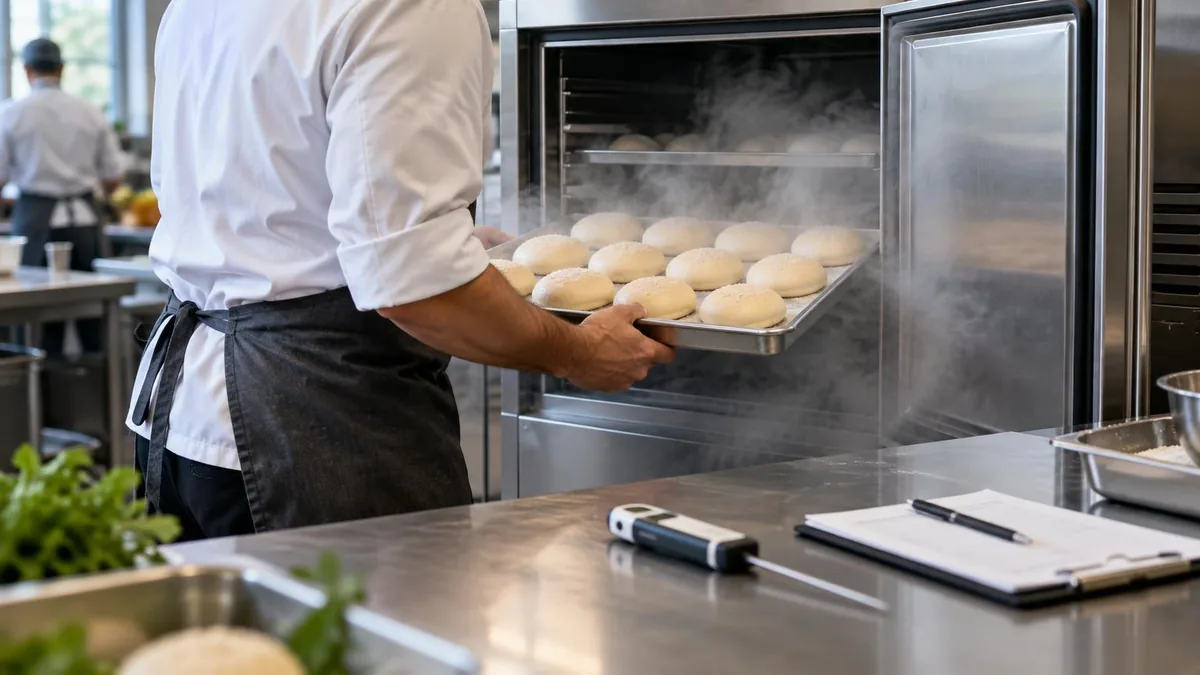
For many burger restaurants, pubs and catering services, burger buns arrive in the kitchen at low temperature. This choice helps reduce waste, plan orders more effectively and keep stock available even when covers vary. In everyday language, though, terms are often used as synonyms when they are not: quick-frozen, frozen, blast-chilled. These differences have practical and regulatory consequences, from storage to communication with customers.
Quick-frozen and frozen: two different categories
Quick-frozen products under Legislative Decree 110/1992
In Italy, quick-frozen food products are governed by Legislative Decree 110/1992, which transposes the relevant EU directive. In summary, a product can be classed as quick-frozen when:
- it undergoes a rapid freezing process, allowing it to pass quickly through the crystallisation phase;
- after thermal stabilisation, it is kept at a temperature of −18°C or below throughout, at every point in the cold chain, within the limited tolerances set out by the regulation;
- it is packaged and labelled with the required information, including the designation "quick-frozen", storage instructions and a warning not to refreeze the product once thawed.
Quick-frozen products are therefore industrial products with precise requirements for process, packaging and labelling.
Frozen products
The term "frozen" generally refers to a food brought down to a sub-zero temperature without necessarily meeting all the requirements for quick-frozen status. This category also includes buns frozen by the manufacturer using processes that do not meet the legal definition of quick-frozen, as well as buns frozen on-site in the restaurant. In practical terms, a frozen product can be of excellent quality: the difference lies in the designation and in the process guarantees.
What about blast chilling?
A blast chiller is a piece of equipment that rapidly cools food. It can operate in positive mode (bringing the product to refrigeration temperature) or negative mode (rapidly taking it below zero). When people talk about "blast-chilled buns", they usually mean buns that have been baked and then rapidly brought to a sub-zero temperature using a blast chiller, either in the bakery or on-site.
In terms of designation, a bun blast-chilled to negative temperatures in the restaurant is a frozen product, not a quick-frozen one: using a blast chiller speeds up the process, but it does not turn the product into a quick-frozen one under Legislative Decree 110/1992. Blast chilling must be included in the procedures of the self-monitoring (HACCP) plan, with consistent record-keeping.
What happens to burger buns when they are frozen
Buns contain water. Slow freezing encourages the formation of larger ice crystals, which can alter the crumb structure and, once regenerated, result in a drier product or a crust that separates. Rapid freezing tends to preserve the structure better, which is one of the reasons why blast chillers and quick-freezing tunnels are preferred over a simple domestic freezer.
The recipe matters too: doughs with higher fat and sugar content, such as brioche buns and milk buns, or potato bun doughs, generally respond well to cold storage, though the outcome always depends on the specific formulation. Packaging is also crucial: a non-airtight pack exposes the bun to surface dehydration and to picking up odours.
Shelf life: what to check
The shelf life of a frozen or quick-frozen burger bun is not a universal figure: it depends on the recipe, the process, the packaging and storage conditions. For pre-packed products, the reference point is the date and instructions on the label, in line with Regulation (EU) 1169/2011, together with the supplier's technical data sheet, which should also state the shelf life after thawing.
For buns frozen on-site, the shelf life must be set out in the restaurant's own self-monitoring plan, in a cautious and documented way, and each pack should be labelled internally with the product name, freezing date and original batch number.
Regeneration in the kitchen
Thawing and regeneration are the stages where most of the quality is either gained or lost. The supplier's instructions always come first; in general, the most common practices are:
- thawing at room temperature, leaving the bun in its sealed pack to prevent moisture loss and to stop condensation forming directly on the crust;
- thawing in a cold room or fridge, which is slower and useful for planning the following day's service, if allowed by the technical data sheet;
- a brief spell in the oven to restore freshness, especially for buns with a firmer crust;
- toasting the cut side on a griddle just before assembly.
A common mistake is thawing more buns than needed: once thawed, the product should not be refrozen, as also required by quick-frozen product labelling, and its shelf life is reduced. It is therefore worth estimating service requirements based on sales history and thawing stock in batches.
Stock management and FIFO
With buns stored at low temperature, stock management becomes simpler, but only if it is well organised:
- apply the FIFO principle (first in, first out): the first product to arrive is the first to be used;
- place new deliveries behind or underneath packs already in stock;
- check the product's temperature and the condition of the packaging on arrival, recording any anomalies;
- avoid overloading the freezer, so as not to compromise air circulation;
- keep a periodic inventory that also accounts for buns already thawed in the fridge or on the line.
A well-sized stock reduces both the risk of running out during peak periods and the risk of products staying in the freezer for too long.
Declaring frozen and quick-frozen products on the menu
In Italy, it is established practice, and a requirement enforced by inspection authorities, to indicate on the menu any products served after having been frozen or quick-frozen. Failing to do so can amount to misleading communication towards the customer and, in more serious cases, the offence of fraud in the exercise of trade (Article 515 of the Italian Criminal Code), as case law has repeatedly confirmed.
In practice, this is done with an asterisk next to the menu item, together with a note such as "product frozen or quick-frozen at origin" or "some products may be frozen or quick-frozen". The reference must be clear and easy to read. This also applies to buns: if the bun arrives quick-frozen, or is frozen on-site, it must be flagged in the same way as other ingredients. The exact wording should be agreed with your food safety consultant, especially where the menu is also available digitally or used for delivery.
Frequently asked questions
Can a bun blast-chilled on-site be called quick-frozen?
No. The term "quick-frozen" is reserved for products that meet the requirements of Legislative Decree 110/1992, including process, temperature and packaging. A bun blast-chilled to negative temperatures in the restaurant is a frozen product.
How long does a quick-frozen bun last?
It depends on the recipe, the process and the packaging. The reference is always the date on the label and the supplier's technical data sheet, which also states the shelf life after thawing.
Do I need to state on the menu that the bun is quick-frozen?
Yes. In Italy, frozen or quick-frozen products must be indicated on the menu, usually with an asterisk and a clear note. For the exact wording, it is best to check with your consultant.
Can I refreeze leftover buns?
It is not advisable: for quick-frozen products, the label itself prohibits refreezing once thawed, and for buns frozen on-site, this is a good practice rule that should be included in the self-monitoring plan. To reduce leftovers, it is best to thaw stock in batches based on expected covers.