Gluten-free burger buns: regulations, kitchen practice and menu wording
Gluten-free burger buns in your kitchen: what Reg. (EU) 828/2014 says, how to avoid cross-contamination, and how to word your menu.
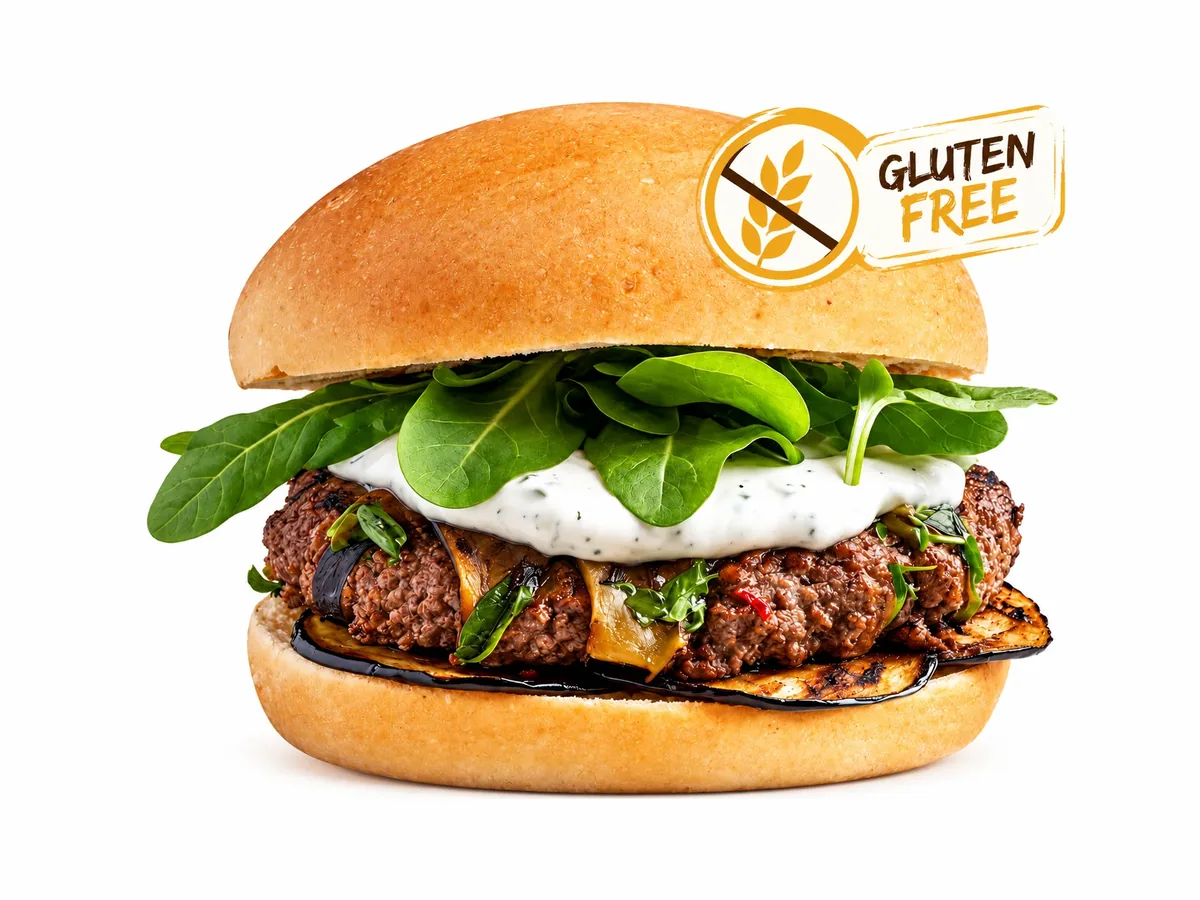
Adding a gluten-free burger bun to the menu is a choice more and more burger restaurants, pubs and venues are considering, as they look to welcome customers who avoid gluten. But it's a choice that needs to be made carefully: the wording "gluten-free" has a precise meaning set out in European legislation, and the result on the plate depends as much on what's bought in as on how it's handled in the kitchen.
This guide summarises the regulations, operational best practice and customer communication. It does not replace your own food safety consultant, who should be involved before introducing the item.
What "gluten-free" means under the law
The reference is Commission Implementing Regulation (EU) No 828/2014, which governs the provision of information to consumers on the absence or reduced presence of gluten in food. Two wordings are permitted:
- "gluten-free": permitted only if the food, as sold to the final consumer, contains no more than 20 mg/kg of gluten;
- "very low gluten": permitted for foods containing one or more ingredients derived from cereals that have been specially processed to reduce their gluten content, where the level in the final product does not exceed 100 mg/kg.
These are two distinct categories and are not interchangeable. A bun labelled "very low gluten" cannot be presented as "gluten-free". The regulation applies to information provided on all foods, including non-prepacked food served by catering and food service establishments: the wording on the menu is therefore, in every sense, information provided to the consumer.
This has an important practical consequence: buying in a bun labelled "gluten-free" is a necessary but not sufficient condition. The 20 mg/kg limit applies to the food as it reaches the customer. If the bun is cross-contaminated during storage, toasting or assembly, the burger actually served may no longer meet the criteria for the claim — and responsibility for that information rests with the venue.
Gluten and allergen information
Alongside Reg. 828/2014 there is Regulation (EU) No 1169/2011, which lists in Annex II the substances that cause allergies or intolerances, including cereals containing gluten. Even for non-prepacked food, venues must be able to provide information on the allergens present in each dish, following the procedures set out in national legislation (for example via the menu, a notice, or documentation available on request, with staff able to answer questions).
For a gluten-free burger, this means knowing every component of the dish, not just the bun: sauces, marinades, coatings, processed cheeses, crispy onions, patties prepared with breadcrumbs. Technical data sheets need updating every time a supplier changes.
Managing cross-contamination in the kitchen
The critical issue isn't the bun itself, but its journey from storage to plate. The most widely used good practices — to be adapted to your own food safety management plan — are as follows.
Separate storage
- Keep gluten-free buns in a closed, clearly labelled container, on a dedicated shelf, ideally above (never below) gluten-containing products to avoid crumbs falling onto them.
- Defrost or regenerate the buns in their original packaging or in dedicated containers.
- Keep utensils such as tongs, knives, boards and spatulas separate too.
Toasting and the griddle
Toasting is the highest-risk step: shared griddles, conveyor toasters and grills build up crumbs and flour residue. The most common solutions are:
- a dedicated toaster or griddle, reserved solely for gluten-free items;
- alternatively, where dedicated equipment isn't feasible, a separate surface (for example a reserved sheet or tray) on a cleaned area, following procedures set out in your own manual;
- for some venues, the choice to serve the bun untoasted or warmed in its packaging, where the product allows it.
The patty needs attention too: cooked on a griddle where gluten-containing buns are toasted, it can pick up residue.
Assembly and service
- Assemble the burger on a clean surface, with fresh gloves and dedicated utensils.
- Use single-portion sauces or dispense from reserved containers, never from the same bottle a knife has already been dipped into.
- Mark the plate or delivery packaging so it doesn't get mixed up along the line.
- For fried items, remember that oil shared with breaded products is a source of cross-contamination: chips aren't automatically suitable if the fryer is shared.
Staff training
No procedure works unless everyone knows it. Training should cover the venue's risk points, how to take orders, and how to answer customer questions, with one point of reference per shift. Any specific local requirements for serving gluten-free meals should be checked with the relevant health authority.
Why choose individually wrapped buns
For many venues, gluten-free bread has lower turnover than the classic bun. Individual wrapping solves two problems at once:
- protection: the bun stays sealed until the moment of use, reducing the risk of contact with flour and crumbs in the kitchen;
- stock management: you open one piece at a time, without having to use up a whole bag quickly.
Many gluten-free products are supplied frozen: defrosting and regeneration should follow the technical data sheet.
Gluten-free recipes use different blends of flours and starches: texture and behaviour when toasted may differ from your usual bun. It's worth testing free samples with the patty and sauces on your menu.
How to word it on the menu
Communication needs to be precise and cautious. Some practical pointers:
- only write "gluten-free bread available" if the product purchased legitimately carries that wording and the venue has procedures in place to prevent cross-contamination;
- if procedures can't guarantee the final result, it's more accurate to state that a gluten-free bun is used while specifying that gluten-containing products are present in the kitchen, and to invite customers to speak with staff;
- avoid absolute claims or promises of suitability for health conditions, and don't attribute nutritional qualities or benefits to the gluten-free bun that it doesn't have;
- don't use symbols or certification marks unless the venue is entitled to use them;
- make information on all allergens in the dish easily accessible, not just gluten.
Customers must be able to clearly understand what they're being served.
Frequently asked questions
What's the difference between "gluten-free" and "very low gluten"?
Under Reg. (EU) 828/2014, "gluten-free" requires no more than 20 mg/kg of gluten in the product as sold to the consumer; "very low gluten" refers to products containing ingredients from cereals processed to reduce gluten, with a maximum content of 100 mg/kg. The two wordings are not interchangeable.
Is it enough to buy bread labelled gluten-free to put it on the menu?
No. The limit applies to the food as served to the customer: if the bun is cross-contaminated in the kitchen during storage, toasting or assembly, the claim may no longer hold. Separation procedures and trained staff are needed.
Do you need a dedicated toaster?
It's the most common solution, since shared toasters retain crumbs and flour. Alternatively, separate surfaces or heating methods can be defined, in line with your own food safety management plan.
Why choose individually wrapped buns?
Because they stay protected until use and allow you to open one piece at a time — useful when turnover of the gluten-free product is lower than that of the classic bun.